Letter Guided: A Simple and Clean Font for Clear Communication
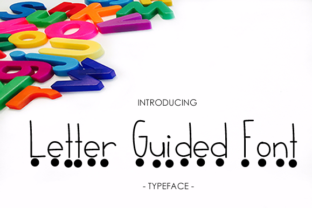
Letter Guided is a font that stands out for its simplicity and readability. Designed with minimal embellishments, it offers a clean visual style that makes it ideal for headlines and other key text elements where clarity is essential. Its straightforward design allows it to blend well with a variety of projects, making it a versatile choice for designers and content creators looking for a reliable typeface.
The appeal of Letter Guided lies in its ability to communicate without distraction. Unlike more ornate or complex fonts, it avoids unnecessary flourishes, focusing instead on legibility and ease of reading. This makes it particularly suitable for situations where the message needs to be clear and direct, such as in signage, editorial layouts, or digital interfaces where users need to process information quickly.
What Makes Letter Guided Distinct?
Letter Guided distinguishes itself through its minimalist approach. Each character is designed with consistent stroke widths and balanced proportions, which contribute to its overall harmony. The font’s lack of decorative elements ensures that it remains unobtrusive, allowing the content to take center stage rather than the typography itself.
One of the key features of Letter Guided is its adaptability. It works well in both digital and print formats, maintaining its clarity across different sizes and resolutions. This versatility makes it a practical option for a wide range of applications, from web headers to marketing materials.
Another notable aspect is its neutrality. Because it doesn’t have strong stylistic traits, Letter Guided can fit into various design contexts without clashing. This neutrality is especially useful when working with other design elements that may have their own visual identity, as it helps maintain a cohesive look without overwhelming the viewer.
How Letter Guided Compares to Similar Fonts
When considering fonts for headlines or focal points, designers often compare options based on readability, aesthetics, and functionality. Letter Guided falls into the category of sans-serif fonts, which are known for their clean lines and modern appearance. However, it differs from many other sans-serif fonts by emphasizing simplicity over complexity.
Fonts like Helvetica or Arial, for example, are widely used for their universal appeal and readability. While these fonts are highly functional, they also carry a certain level of familiarity that can make them feel less distinctive. Letter Guided, on the other hand, offers a fresh alternative that retains the same level of clarity but with a slightly more unique character.
Other fonts with similar goals, such as Open Sans or Lato, also prioritize readability and versatility. However, they often include subtle details that can affect how they appear in different contexts. Letter Guided avoids these subtleties, making it a more neutral choice for projects that require a straightforward, no-nonsense look.
Strengths and Tradeoffs of Using Letter Guided
One of the main strengths of Letter Guided is its ability to enhance readability without drawing attention to itself. This is particularly beneficial in scenarios where the primary goal is to convey information efficiently, such as in news articles, product labels, or user interface elements. Its clean design ensures that readers can focus on the message rather than the typography.
Another advantage is its compatibility with other design elements. Because it doesn’t have strong visual characteristics, it pairs well with a variety of other fonts and color schemes. This makes it an excellent choice for projects that require a balanced and harmonious visual composition.
However, there are tradeoffs to consider. For instance, while its simplicity is a strength in many cases, it may not be the best choice for projects that require a more expressive or stylized appearance. If the goal is to create a bold or artistic statement, a more distinctive font might be more appropriate.
Additionally, because of its minimalistic design, Letter Guided may not stand out as much in competitive environments where differentiation is key. In such cases, a font with more unique features could be more effective in capturing attention and reinforcing brand identity.
Best-Fit Situations for Letter Guided
Letter Guided is particularly well-suited for projects that prioritize clarity and accessibility. For example, in educational materials, it can help ensure that students can easily read and understand the content. In corporate communications, it provides a professional and trustworthy appearance that aligns with formal branding guidelines.
It is also a good choice for digital interfaces where usability is a priority. Whether it’s a website header, a mobile app label, or a dashboard title, Letter Guided’s clean design helps users navigate and interact with content more effectively.
In addition, it works well in environments where multiple languages or scripts are used. Its simple structure reduces the risk of misinterpretation, making it a reliable option for international audiences.
When Other Options Might Be Better
While Letter Guided is a strong choice in many situations, there are instances where other fonts may be more appropriate. For example, if the goal is to create a strong visual identity, a more distinctive font could help differentiate a brand or project from competitors. Fonts with more personality or variation can add depth and character to a design, which may be necessary for creative or artistic endeavors.
Similarly, in contexts where the font needs to convey emotion or tone, a more expressive typeface might be better suited. For instance, a script font could be used to evoke a sense of elegance or informality, depending on the desired effect. In these cases, the simplicity of Letter Guided may not provide the same level of emotional resonance.
Another consideration is the scale at which the font will be used. While it performs well in medium to large sizes, it may not be as effective in very small text, where fine details can become difficult to distinguish. In such cases, a font with more contrast or detail might be preferable.
Practical Examples and Use Cases
Consider a scenario where a company is designing a new website. They want the headline to be easy to read and visually appealing. By choosing Letter Guided, they can ensure that the text is clear and accessible, without distracting from the overall design. This approach supports a user-friendly experience while maintaining a professional aesthetic.
In another example, a designer working on a brochure for a local museum might use Letter Guided for the title and section headings. The font’s simplicity allows the images and content to take precedence, creating a balanced and engaging layout that guides the reader through the material without confusion.
For a mobile application, using Letter Guided for buttons and labels can improve usability by ensuring that users can quickly identify and interact with the interface. Its clean design reduces visual clutter, making the app more intuitive and easier to navigate.
Conclusion: Choosing the Right Font for Your Needs
Letter Guided is a practical and effective font for projects that require clarity, simplicity, and readability. Its clean design makes it ideal for headlines, digital interfaces, and other applications where the focus should be on the content rather than the typography itself.
However, the decision to use Letter Guided should be based on the specific needs of the project. If the goal is to create a strong visual identity or convey a particular tone, other fonts may offer more flexibility and impact. Evaluating the purpose, audience, and context of the design is essential in determining whether Letter Guided is the right choice or if an alternative would be more suitable.